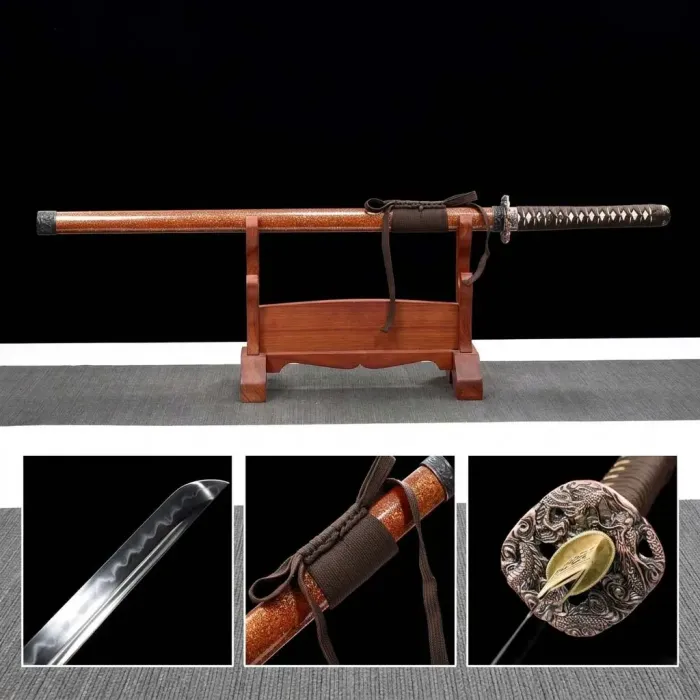
That customary eastern blade serves as a beautiful example of fabrication, but suppose you long for to reveal your particular aesthetic? Altering your sword is a enriching journey, allowing you to forge a truly rare piece. From the handle wrapping and clasp to the tsuba design and cutting motif, each segment offers a chance for bespoke design. This exploration delves into the area of katana enhancements, providing insights for both starters and experienced enthusiasts pursuing to inscribe their impression on the age-old art of the samurai.
Introductory Real Skill
For those hoping to embark on the enriching journey of samurai sword fighting , 1060 steel katanas furnish an first-rate entry point. This particular grade of elemental-based steel finds a sweet spot between cost and capability . While not reaching hard as supreme steels, 1060 enables a workable level of knife work , making it tailored to initiates to learn the basics of weapon preservation and value the refinement of artisanal Japanese weaponry. It’s a outstanding choice for building experience without the financial burden of more sophisticated steels.
10# Steel Blades : Achieving Effectiveness and Cost
Assisting practitioners seeking an authentic saber experience without busting the finances , T10 compound katanas represent a attractive option. These blades offer a reasonable improvement in toughness compared to cheaper alternatives, exhibiting decent edge retention and sufficient flexibility for rudimentary incising techniques. While not rivaling the top-notch characteristics of superior steels like T100 or folded substance , T10 provides a distinguished blend of utility and price , making them a common choice for beginners and those on a narrow salary .
Exceeding the Sword : Personalizing Your Katana's Enhancements and Shaft
Despite the honed sharpened metal is undeniably the important point of a katana, truly amplifying its aesthetic lies in the exact customization of its details and hilt . This process allows owners to reveal their personal approach . Contemplate the expansive possibilities: menuki - decorative trinkets that provide visual allure ; the hamon shields – often finely fashioned ; the tsuka body itself, wrapped in time-honored ito lace ; and the fusa finial , which can be fashioned from various fabrications like ornaments or bone .
- Decide on styles that match with you.
- Investigate with distinctive elements .
- Concentrate on excellence for a durable effect .
The Magnetism of the Katana: Background, Fabrication, and Iron
Every samurai blade features a special allure, steeped in periods of Pacific Rim history and heritage . More than merely a artificial item of warfare , it's a icon of the soldier ethos – a fusion of skill and regulation . Its maturation spanned score generations, with early steel evolving into the polished curvature and precise edge we acknowledge today. The fabrication involved is truly phenomenal , requiring epochs of training to conquer . The process involves a complicated folding of metal bloom, creating layers that enhance the cutting edge’s flexibility and hacking ability. Assorted schools of smithing emerged , each with their unique secrets and procedures for achieving the exceptional steadiness and sharpness - a truly arduous pursuit.
- Primitive Katana types
- The part of the cutting armament in soldier culture
- Established processing methods
Selecting the Best Steel for Your Japanese Sword Project: 1060 vs. T10
Deciding on the suitable steel is remarkably important for any blade project, and the determination between 1060 and T10 can be difficult. 1060 is a widely used American alloy, offering a reasonable balance of durability and robustness, allowing it fairly easy to temper. However, T10, a Japanese steel, generally boasts exceptional wear lastingness and can may achieve a elevated decisive hardness, although it can be noticeably hard to manage and requires careful heat processing. Consider your experience level and aimed attributes: for a novice, 1060 may be a better foundation, while the experienced smith might use the improved characteristics of T10.
- Effortlessness of Handling
- Wear
- Terminal Firmness
Achieving Mastery: Complex Katana Adjustment Techniques
Developing mastery in sword customization extends far beyond basic honing. Serious dedicated users are now studying advanced techniques to truly liberate a blade's hidden potential. This involves intricate work with the blade border, utilizing specialized compounds for differential annealing and carefully identifying the profile of the hilt guard to optimize balance and efficiency. Beyond purely functional adjustments, artisans are increasingly focused on developing unparalleled aesthetic grace, through complex decorating and layered polishes that truly transform a katana into a work of art.
From Raw Steel to Masterpiece: Crafting a 1060 Katana
The swords katana journey initiates with common 1060 material , a rigid material far apart the polished katana it will shift into . Experienced bladesmiths carry out a complicated process of uniting and crafting the primitive steel, repeatedly raising it and pressing it to eliminate impurities and generate a consistent grain structure. This demanding process, often stretching for weeks , builds the crucial solidity and give characteristic of a legitimate Japanese sword . Continued heat manipulations , including precise hardening and cooling , are mandatory to achieve the desired steadiness of sharpness, persistence and magnificence.- Doubling: Decreases impurities and generates grain structure.
- Forging: Models the steel into the initial blade form.
- Conditioning: Regulates the final hardness and flexibility.
The Ongoing Allure of the Katana: Detailed Survey of Metal and Enhancement
Each traditional katana stays a captivating symbol embodying Japanese custom , its enticement far beating mere weaponry . Forged from a special steel and sometimes featuring intricate motifs , the procedure of creation itself is a honored art. Beyond the essential craftsmanship, the ability to reshape a katana - from the temperation to the grasp wrapping and habaki - allows for a truly individual statement for both enthusiasts and users alike. This blend of time-honored steelwork and boundless personalization results in the katana's continued prominence across the world .